
Inside the State Library of Western Australia Rare Books Collection: |
Uncover hidden treasures and literary wonders in the rare books collection at the State Library of Western Australia. |
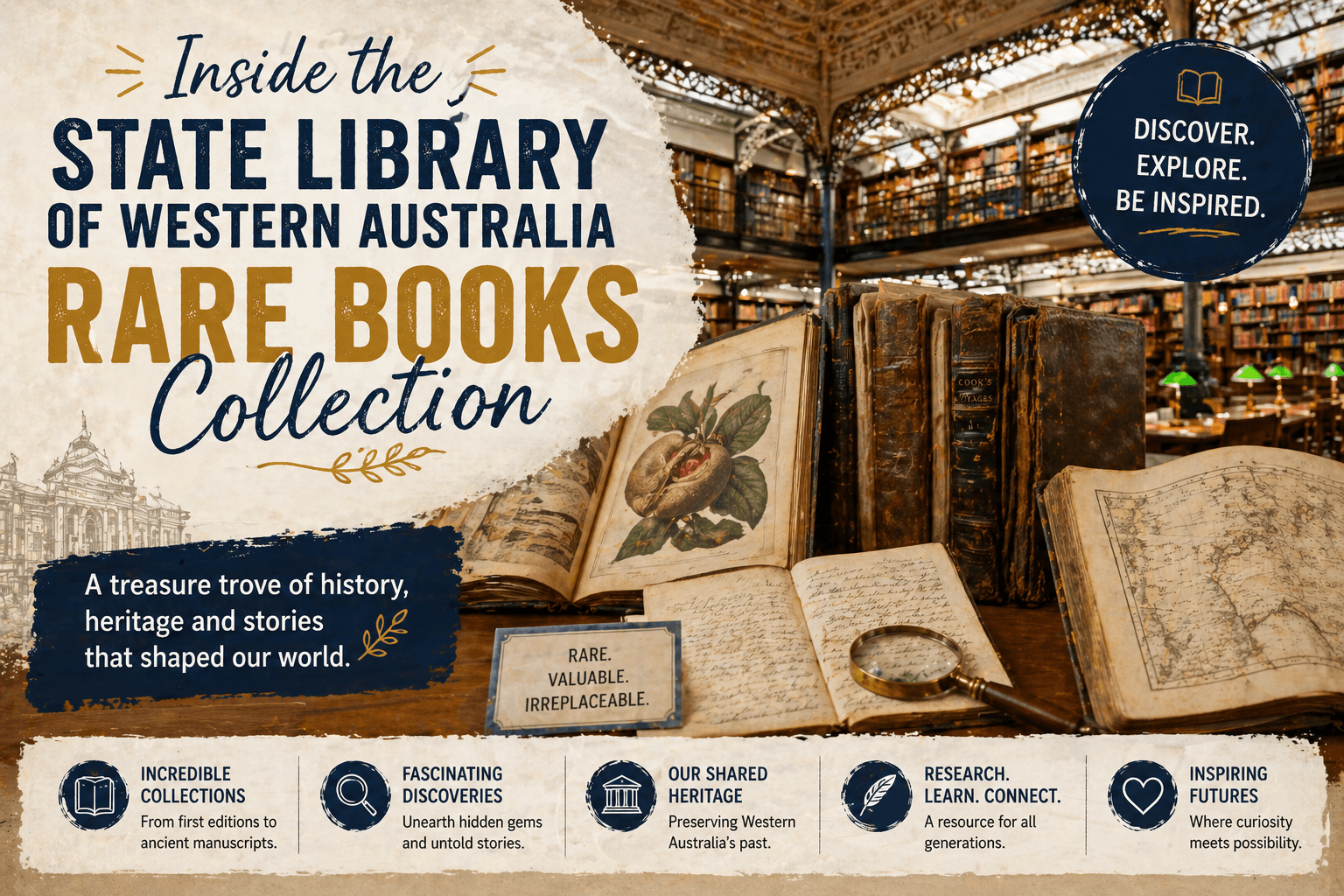
Walk through the doors of the State Library of Western Australia in Perth, and you step into a quiet cathedral of knowledge. Sunlight filters softly across polished surfaces, mingling with the hushed whispers of pages turned and minds engaged. Yet beyond the public stacks lies a world most visitors never see: the Rare Books Collection. Here, centuries of Western Australia’s literary and historical heartbeat are preserved, fragile, irreplaceable, and whispering secrets to anyone patient enough to listen.
This isn’t just a collection. It is a bridge across time. A conversation with explorers, settlers, and thinkers long gone. A place where every crease, annotation, and gilded edge matters. And the stories it holds, of discovery, creativity, and human endeavor, are waiting for the curious, the scholar, the collector.
What Makes the Rare Books Collection So Exceptional?Not all books are created equal.
The Rare Books Collection occupies a space where history and materiality collide. These are not your everyday volumes. They are manuscripts whose ink has survived centuries, printed editions that were never meant for mass eyes, and bound treasures whose bindings themselves are works of art.
Inside, you’ll find:
Every item is stored with almost reverential care: climate-controlled rooms, precise humidity, careful lighting. It’s not just preservation; it’s stewardship. The library is protecting Western Australia’s memory, a treasure too precious to risk.
Why this matters to you: Even a casual visitor feels it—the pull of history. Curiosity stirs. You’re drawn not only to the words but to the lives that produced them, to the human impulses that shaped a culture. It’s irresistible.
Discovering the Collection’s Hidden Treasures
Step closer, and the collection unfolds like a map of a forgotten world. Early Western Australian publications capture the daily rhythms of life in the 19th and early 20th centuries. Newspapers, pamphlets, and locally printed books offer a tactile glimpse into society’s hopes, fears, and ambitions.
Exploration narratives and colonial texts are windows into uncharted lands. The journals of surveyors and adventurers carry the exhilaration, danger, and awe of discovery, stories that textbooks can only hint at. Then there are the limited editions and fine press works, objects of desire for collectors. Each one, with its handcrafted paper, unique binding, and precise typography, feels like holding history itself in your hands.
And finally, the manuscripts and illustrated volumes, fragile yet magnetic. Maps, letters, and annotated texts create layers of story beyond the written word. You are not just reading; you are witnessing.
Emotional pull: The mind hungers for rarity. Authority, mastery, and discovery intertwine. You are not merely a visitor; you are a participant in a continuum of knowledge.
How You Can Access These Treasures
The Rare Books Collection does not hand itself over casually. Access is a ritual, a choreography of preparation and anticipation.
Registering as a researcher or member is the first step. The library welcomes anyone genuinely interested, but your intent matters; these treasures are too delicate for casual browsing.
Viewing protocols are exacting. Gloves, supports, and gentle handling are not bureaucratic rules; they are the difference between centuries preserved and centuries lost.
Requesting items from closed stacks is part of the magic. Every retrieval is orchestrated, a careful dance that brings fragile history into your hands without harm.
Some items have digital counterparts, high-resolution scans that allow remote exploration. Yet nothing fully replaces the experience of seeing a faded page, smelling the paper, and feeling the weight of history beneath your fingers.
Psychological insight: Step-by-step guidance reduces anxiety. It transforms the intimidating into the achievable.
Every instruction reassures, empowers, and fuels a subtle sense of mastery. Preservation, Conservation, and Cultural Stewardship
The care devoted to these books is meticulous.
This is stewardship with soul. The library is not merely storing books; it is guarding memory, identity, and culture.
Planning Your Visit to Perth’s Cultural Heart
Situated in the Perth Cultural Centre, the State Library is surrounded by art, history, and civic life. A visit can become an immersive day of exploration:
This is a journey for senses and intellect alike: the smell of old paper, the visual pleasure of ornate bindings, the quiet satisfaction of understanding something previously inaccessible.
Human resonance: By framing the visit as an experience, the reader is invited into a narrative, not a set of instructions. Identity, curiosity, and belonging converge.
Questions That Linger in Every Researcher’s Mind
Who can really access these books?
Are any of the rare books online?
Can I take photos?
Why does it matter at all? |
0 Comments
Join the conversation
Be the first to comment
Share your thoughts above.