
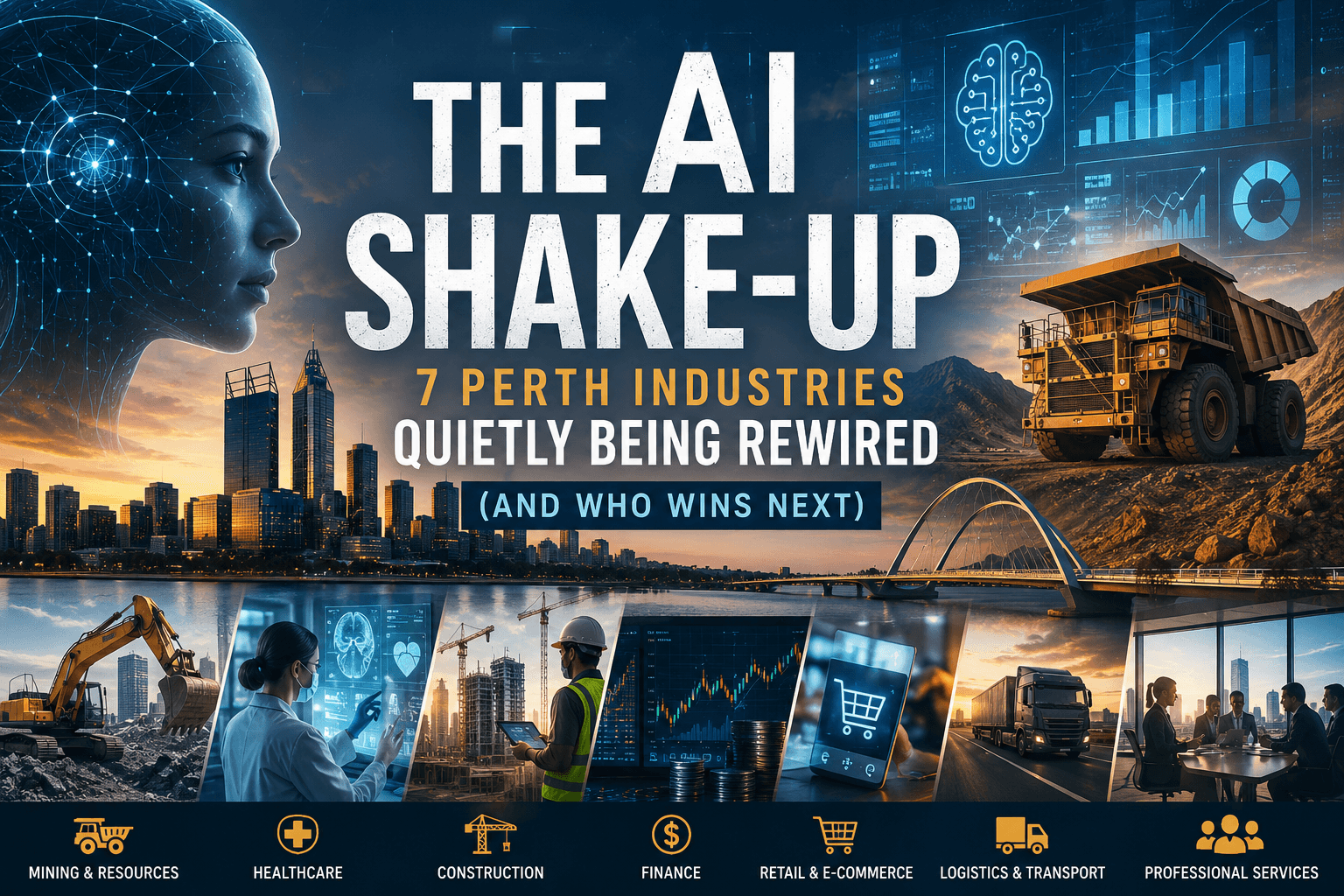
The AI Shake-Up: Seven Perth Industries Quietly Being Rewired and Who Wins Next |
Unveiling the Silent Transformation: How AI is Revolutionizing Perth's Industries and Who Comes Out on Top. |
Spend enough time in Perth, and you begin to notice something changing beneath the surface of the city's working life. It does not arrive with fanfare or sudden seismic disruption. It announces itself in subtler ways, in decisions that happen faster than they used to, in teams that have quietly grown leaner, in systems that seem to anticipate what comes next before anyone asks.
Artificial intelligence has not stormed the economy. It has slipped in quietly, through the side door, settling into workflows before most people have had a chance to ask whether it belongs there.
That, precisely, is what makes it so powerful.
While many people are still debating whether AI will replace jobs, something far more precise is already well underway. The nature of work itself is being reshaped gradually, persistently, almost imperceptibly, until entire industries begin to feel fundamentally different from the inside. The headlines have not caught up yet. In many cases, neither do the workers.
Jobs rarely disappear overnight. They do not vanish in a single dramatic moment that everyone can point to. Instead, parts of them quietly fade away, eroded by automation and algorithmic efficiency, until what remains no longer looks or feels the same.
A role that once required ten distinct skills may now require four, the other six having been absorbed by software that never sleeps, never makes arithmetic errors, and never needs a coffee break.
That is where the real transformation lies, not in a sudden revolution, but in the slow, steady erosion of the familiar.
What AI is actually changing in Perth right now
It is tempting to think in extremes when the subject is artificial intelligence. Replace or survive. Win or lose. Adapt or be left behind. Yet AI does not operate in such blunt, binary terms. It works in layers, infiltrating systems and processes in ways that are often invisible until their cumulative effect becomes undeniable.
It removes friction from processes that have always carried it. It accelerates analysis that once took days or weeks. It reduces the repetition that has quietly exhausted knowledge workers for decades. In a city such as Perth, where mining, infrastructure, professional services and a growing technology sector together shape the economy, those changes spread quickly and widely.
The ripple effects spread from one industry to the next, affecting supply chains, labour markets, professional skills and the very definition of a productive working day.
Here is the shift most people overlook.
AI does not eliminate jobs wholesale. It rearranges the value within them. It redistributes wealth. The tasks that once justified a salary are quietly automated, while the tasks that remain, judgement, creativity, relationship-building, and ethical reasoning, grow more important precisely because they cannot be replicated by a model trained on historical data.
So rather than asking whether your job will disappear, a more useful and more urgent question presents itself: which parts of your work are already changing, and which parts will matter most when they do?
That is where awareness begins and where preparation can make a genuine difference.
The seven industries in Perth are quietly being rewired 1. Mining and resources: from physical labour to intelligent systems.
Mining has long been defined by scale, physical effort and the sheer logistical complexity of extracting resources from some of the most remote and demanding terrain on Earth. Western Australia's mining sector has shaped Perth's identity for generations.
Today, it is becoming something more refined, and the transformation is accelerating.
Equipment failures are predicted before they occur, using sensor data and machine learning models that identify patterns invisible to human operators. Geological modelling is guided by intelligent systems capable of processing vast datasets and producing probabilistic assessments of where valuable deposits are most likely to be found.
Autonomous vehicles and drilling systems operate across remote sites with minimal human intervention, improving safety outcomes while cutting operational costs.
This does not feel like a disruption from inside the industry. It feels like evolution, a natural continuation of the mechanisation that has been reshaping mining for over a century. But the pace has changed.
Workers are no longer solely operators of physical equipment. They are increasingly becoming supervisors of complex, interconnected digital systems. The ability to understand both the physical environment, the geology, the terrain, the equipment, and the digital layer sitting above it has become a genuine competitive advantage for individuals in the sector.
Those who develop fluency across both domains are finding themselves increasingly valuable. Those who resist the digital transition risk being overtaken by colleagues, or, in some cases, by systems that do not share that reluctance.
2. Healthcare: where clinical precision meets irreplaceable human care.
In Perth's healthcare sector, the changes wrought by AI are perhaps less visible to patients but profoundly significant in their implications for clinical practice and operational efficiency.
Medical imaging analysis, traditionally a time-intensive process requiring expert radiological review, is being transformed by AI systems capable of identifying early markers of disease with a degree of accuracy that rivals, and in some narrow contexts surpasses, that of experienced clinicians. Conditions that might once have been caught at a later stage are being identified sooner, when treatment outcomes are typically far better.
Administrative work, appointment scheduling, patient record management, billing, and compliance documentation is increasingly handled by automated systems running quietly in the background. This frees clinical staff from tasks that consume time without drawing on their specialist expertise, allowing them to focus on the work that actually requires their training and judgement.
As these systems improve, something somewhat unexpected begins to happen. Human qualities do not diminish in value; they increase. Patients still seek reassurance from another human being. They still need empathy, honest communication and the sense that someone who understands their situation is genuinely present with them.
These qualities cannot be automated, no matter how sophisticated the underlying model. A diagnostic system can identify a tumour; it cannot sit with a patient while they process what that diagnosis means for their life.
So while AI strengthens clinical precision and alleviates administrative burden, it simultaneously elevates the value of the human qualities that define genuinely good care. The clinicians who thrive in this environment will be those who embrace the tools without losing sight of the patient on the other side of the consultation.
3. Construction: fewer surprises and greater certainty in a notoriously unpredictable sector.
Construction has traditionally carried a level of uncertainty that has frustrated clients, contractors and project managers alike. Budgets drift. Timelines extend. Unexpected ground conditions, supply chain disruptions and coordination failures conspire to make even well planned projects feel perpetually subject to the unexpected.
AI is beginning to change that, and the impact on Perth's construction sector, which has been buoyed by substantial infrastructure investment and housing demand, is already discernible.
Costs are now forecast with greater accuracy using predictive models that draw on historical project data, material price trends and labour market conditions. Risks are identified before work begins rather than discovered mid-project when they are far more expensive to address. Scheduling tools can anticipate bottlenecks and model the downstream consequences of delays before they cascade through a project plan.
The nature of the work is evolving as a result. Less time is spent reacting to problems that have already materialised. More time is spent planning, modelling scenarios and making decisions based on evidence rather than experience alone.
This shift is creating a new premium on a particular kind of professional: someone who can interpret data fluently and apply it alongside deep practical experience of how construction projects actually behave on the ground. The purely intuitive project manager, operating on gut feeling and years of hard won wisdom alone, is not obsolete. But they are increasingly complemented, and in some contexts being surpassed, by those who combine that wisdom with analytical capability.
4. Finance and accounting: moving beyond manual processes towards strategic insight
Few sectors feel the shifting ground beneath them as clearly as finance and accounting. The core activities that have defined entry-level and mid-level roles in this sector for generations- data entry, reconciliation, bookkeeping, compliance checking are increasingly automated, handled by software that processes transactions more quickly and with fewer errors than any human team.
Bookkeeping, in its traditional form, is becoming a largely automated function. Compliance checks run continuously in the background, flagging anomalies and potential breaches in real time rather than during periodic audits. Fraud detection systems analyse transactional patterns at a scale and speed no human analyst could replicate, identifying suspicious activity far earlier in the process.
As routine work fades from the professional landscape, a new emphasis emerges, and it is one that genuinely requires human capability. Insight matters more than process. The ability to interpret financial information to contextualise numbers within a broader business narrative, to anticipate the strategic implications of trends, and to communicate complex financial realities to non-financial stakeholders is becoming the defining value that finance professionals offer.
Professionals who can provide that kind of strategic guidance, who can translate data into decisions, are becoming substantially more valuable than those focused solely on execution. The Perth firms that recognise this shift early and invest in developing those higher-order skills among their people are positioning themselves well for the decade ahead.
5. Retail and e-commerce: shaped by personalisation at scale.
Retail in Perth, as elsewhere, has moved far beyond the confines of physical space. The question of how to create compelling, personalised experiences across digital channels is now at the centre of the industry's competitive landscape, and AI is the primary mechanism through which those experiences are being built and refined.
Shopping experiences are tailored to individual behaviour. Recommendations are generated based on browsing history, purchase patterns and real-time context, creating a sense of relevance that generic merchandising could never achieve. Pricing adjusts dynamically in response to demand signals, competitor activity and inventory levels. Inventory itself is managed more efficiently through predictive models that reduce the cost of over-stocking whilst minimising the customer frustration of stock-outs.
Customers may not consciously notice the systems behind these changes. What they notice is the result: experiences that feel more relevant, transactions that feel more seamless, and service that increasingly anticipates their needs rather than merely responding to them.
This raises expectations across the board. What feels like a thoughtful, personalised experience today quickly becomes the baseline expectation tomorrow. Retailers who fail to keep pace find themselves offering something that feels dated by comparison.
Those who understand customer behaviour deeply and who can combine data literacy with genuine empathy for what motivates purchasing decisions are at the very centre of this transformation.
The skill is not simply in deploying the tools; it is in understanding the human beings on whose behalf those tools are being deployed.
6. Logistics and transport: driven by the imperative of efficiency.
Perth has always depended on strong, reliable logistics infrastructure. Its geographic position, remote from every other major Australian city, and further still from key international markets, means that supply chain efficiency is not merely a competitive advantage but a fundamental operational necessity. Even small improvements in logistics performance compound into significant savings and service improvements over time.
AI is refining this system in ways that are individually incremental but collectively transformative.
Delivery routes are optimised in real time, adjusting dynamically to traffic conditions, driver availability and customer location clustering. Demand is forecast with greater accuracy, allowing operators to position stock, vehicles and personnel more efficiently. Operational delays and the friction points that have always eaten into margin and eroded customer confidence are identified earlier and addressed more proactively.
The improvements may appear modest in any given week. But the cumulative effect, sustained over months and years, is a reshaping of entire supply chains.
Operators who have embraced AI-driven optimisation are finding themselves able to do more with the same resources or the same with fewer. In a sector where margin pressure is constant and customer expectations are rising, that efficiency advantage is significant.
The roles that are growing in this environment are those that sit at the intersection of operational knowledge and data fluency: people who understand how supply chains actually behave under pressure, and who can use intelligent tools to anticipate and manage that pressure more effectively.
7. Professional services: strengthened and accelerated by augmented intelligence.
Across fields such as law, marketing, consulting, public relations and communications, AI is not replacing professionals; it is augmenting them in ways that are reshaping the pace and scale at which they can operate.
Legal research that once required hours of case law review can now be completed in minutes. Marketing content is produced at a pace that was previously impossible without large teams. Data analysis that would once have demanded a specialist and several days of work can now be completed by a generalist with the right tools in an afternoon.
This creates a compounding advantage for those who embrace the shift. An individual who is fluent in AI tools can now deliver work that previously required a team. A small firm that adopts these capabilities can compete at a level previously reserved for much larger operations. But it also creates a compounding disadvantage for those who do not. As the gap between AI-augmented professionals and those working by traditional methods widens, the difference in output, speed and cost becomes increasingly difficult to ignore.
A client given the choice between a firm that can produce a first draft in two hours and one that takes two days will need a compelling reason to choose the latter.
The distinction is gradual until it is not. Then it becomes very visible indeed.
The real risk no one discusses openly...
There is a common assumption that the most basic, entry level roles face the greatest threat from automation. The logic seems intuitive: simple tasks are easier to automate than complex ones. Why would a sophisticated system bother with work that requires deep expertise?
In reality, the risk often sits in a different place, and it sits there quietly, which is part of what makes it so significant.
Roles that rely on structured, repeatable thinking are particularly exposed. They sit in the uncomfortable middle ground: containing just enough apparent complexity to feel secure, yet just enough predictability for AI systems to handle effectively, or soon will be able to. Roles built primarily around synthesising available information into structured documents, processing standard compliance requirements, or applying established frameworks to routine situations fall into this category.
The highly skilled specialist, the surgeon, the barrister, the architect with twenty years of domain expertise, remains robustly valuable. The purely manual worker in roles that require physical dexterity in unpredictable environments remains, for now, largely beyond what current AI systems can displace. It is the structured middle: the analyst, the junior lawyer, the junior accountant, the research coordinator, where the pressure is most acutely building.
Once you recognise this pattern, it becomes visible across industries in Perth and beyond.
The people are quietly moving ahead.
Every significant period of economic change creates opportunity. The challenge is that the opportunity is rarely obvious from the outside, and it rarely arrives in the form you expect.
The individuals progressing most effectively through this transition are not attempting to compete with AI on its own terms, a contest they would inevitably lose. They are learning how to work alongside it in ways that amplify their own distinctly human capabilities.
They experiment with tools, not to become technology experts, but to understand practically what these tools can and cannot do. They adapt their approach, identifying which parts of their work benefit from augmentation and which parts require the kind of nuanced human judgement that no current system can replicate. They build on existing expertise, using AI to do more of what they already do well rather than starting from scratch.
Over time, the cumulative effect is substantial. Their roles expand rather than contract. They move from completing tasks to directing systems, from execution to strategy, from following processes to designing them. This is not a story about exceptional individuals with rare technical gifts. It is a story about the consistent application of curiosity and adaptability, qualities that have always distinguished those who navigate change successfully from those who are overtaken by it.
So where does that leave you?
Not at a dramatic turning point requiring an immediate, wholesale reinvention of your career. Rather, at the edge of a gradual shift that rewards early awareness and incremental, sustained adaptation.
The advantage in this environment does not come from predicting the future perfectly or making dramatic pivots. It comes from noticing patterns early, asking the right questions, and responding thoughtfully rather than reactively.
That means taking time to understand how AI tools apply to your specific work, not in the abstract, but concretely and practically. It means identifying where automation genuinely improves efficiency and where human input not only remains essential but becomes more valuable precisely because routine work is being automated around it.
It means developing the skills, judgement, creativity, communication, emotional intelligence, and ethical reasoning that are genuinely difficult to replicate and that grow more important as the tasks surrounding them are systematically automated.
These are not new skills. They are, in many cases, the skills that have always mattered most. What AI has done is sharpen the focus on them by removing the noise of repetitive process work that used to obscure them. |
0 Comments
Join the conversation
Be the first to comment
Share your thoughts above.