
Melville, Perth: A Complete Suburb Guide to One of Western Australia's Most Established Neighbourhoods |
Discover the charm and history of Melville, Perth - your ultimate guide to this timeless Western Australian neighborhood. |
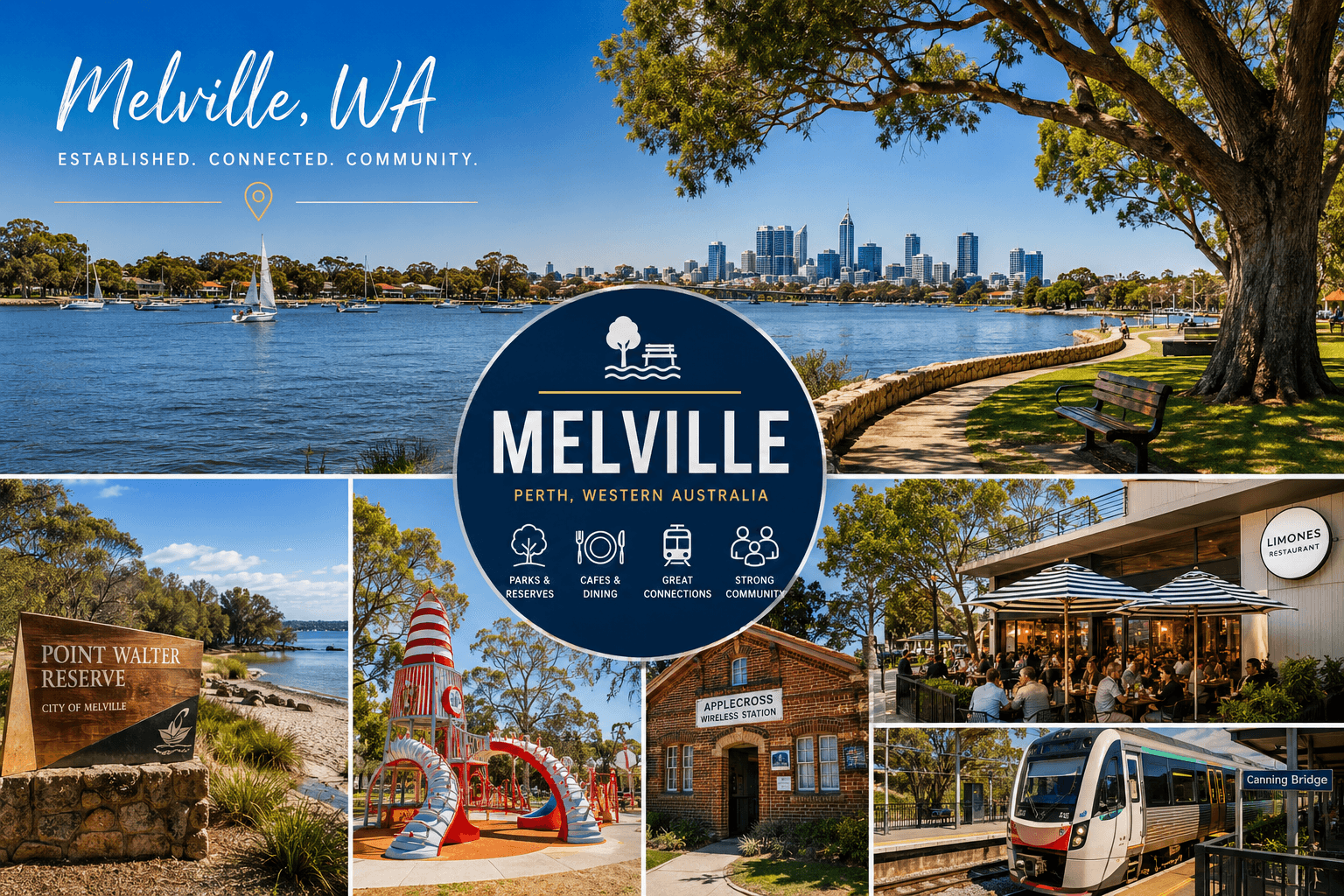
Sitting quietly along the southern banks of the Swan River, approximately eleven kilometres from Perth's central business district, Melville is one of those suburbs that rewards attention.
It does not shout for it. There are no sprawling tourist precincts or flashy landmarks competing for visitors' cameras. What Melville offers instead is something rather more enduring: genuine community character, remarkable green space, a fascinating industrial history most Australians know nothing about, and a dining scene that has grown quietly confident over recent years.
Whether you are considering making Melville your home, planning a weekend visit, or simply curious about what lies beyond the better-known suburbs along the river corridor, this guide covers everything worth knowing.
A Suburb With a Name Worth Knowing
The name Melville carries more history than most residents realise. The suburb takes its name from Melville Water, a section of the Swan River, which was itself named after Robert Dundas, 2nd Viscount Melville, by Governor James Stirling during the earliest years of the Swan River Colony. Yet there is another, older layer of meaning beneath the colonial naming.
The suburb name is also believed to be of Aboriginal origin, meaning the place of the Karda, or Racehorse Goanna, a detail that speaks to the deep Noongar heritage woven into this landscape long before European settlement arrived.
Settlement was minimal until the 1890s, due largely to isolation and the limitations presented by the swampy foreshore. Growth was gradual from the late 1800s to the early 1900s, reaching a population of around 2,000 by 1913, with the most significant development occurring in the post-war years, particularly throughout the 1950s when the suburb took much of the shape it retains today.
Who Lives in Melville?
Melville is an affluent inner-southern suburb with a population of approximately 6,200 people spread across just 2.4 square kilometres, making it a tightly settled residential area characterised by quality period housing, tree-lined streets and a median household income comfortably above the Perth metropolitan average.
The median age of 42 reflects a mature and established community of professionals and long-term owner-occupiers, many of whom have no intention of leaving.
The broader City of Melville local government area, which encompasses the suburb and the surrounding neighbourhoods, is home to more than 103,000 people across 52.73 square kilometres. It is a genuinely diverse and multicultural community that enjoys a rich built and natural heritage, a blend of retail and business precincts, and an abundance of opportunities for physical and social activity within a unique natural landscape. The area draws a mix of young families, long-established residents and professionals working in central Perth, many of whom value the suburb's unusual combination of leafy quiet and urban accessibility. It consistently ranks among Perth's most desirable addresses on the southern river corridor, and property here reflects that reputation accordingly.
Parks, Reserves and Green Spaces
Few suburbs in Perth's southern corridor can match Melville and its surrounding area for the sheer quality and variety of its open spaces.
The City of Melville boasts more than 200 parks and reserves, 778 hectares of public open space and 295 hectares of bushland. That is a remarkable figure for an urban local government area, and it is one that locals take genuine pride in.
Point Walter Reserve is a large riverside reserve offering idyllic views of the Swan River, located in the neighbouring suburb of Bicton on Honour Avenue. Its size, natural beauty and abundance of facilities make it the perfect location for any occasion, from a casual family outing to a large outdoor wedding. What makes Point Walter genuinely extraordinary is a natural quirk that draws visitors year-round: when the tide retreats, you can walk from the foreshore out into the river along the Point Walter Sandbar. This phenomenon feels almost surreal on a still summer morning and makes for a photograph quite unlike anything else in the metropolitan area. A golf course sits within the reserve as well, alongside mountain bike trails catering to riders of all experience levels.
Then there is Wireless Hill Park, one of the most historically significant green spaces in the entire Perth metropolitan area. The park encompasses 40 hectares and was previously the site of a large radio mast operated by the Overseas Telecommunications Commission for much of the twentieth century.
The site contains excellent jarrah and marri woodland with an understorey of banksia and casuarina, and it provides a brilliant display of wildflowers in spring that draws bushwalkers from across the city. The park contains three walking trails ranging in length from 700 metres to three kilometres, as well as picnic areas, barbecue facilities and an observation platform that offers sweeping views across the river and the wider city.
Kadidjiny Park, bounded by Curtis and Kitchener Roads in the heart of the suburb, is the local favourite for families with young children. Its name is a Noongar word meaning "learning", a lovely nod to its history on the former Melville Primary School site and its enduring role as a gathering place for local families and school groups. The City of Melville redeveloped the site into a 9.5 million dollar landmark park that opened in 2010, complete with a playground, an amphitheatre and extensive green space.
The red and white design motifs scattered throughout the park have earned it the affectionate nickname of the Dr Seuss Playground among locals, and it is one of those places that manages to feel genuinely joyful on any given afternoon. The main playground is fully fenced and gated, the surfaces are largely soft-fall, and the broad surrounding lawns are ideal for scooters, bikes and impromptu picnics.
A Quirky Piece of History Hidden in Plain Sight
One of Melville's most fascinating and least-told stories sits at the heart of Wireless Hill Park. The Applecross Wireless Station was built in 1912 by the German company Telefunken and used before, during and after both World Wars to communicate with ships navigating distant waters and with Antarctic bases. It was also, remarkably, the first transmission site for Perth radio station 6PR. The original buildings were retained following decommissioning in 1967, and the land was eventually vested in the City of Melville as a public reserve and museum of telecommunications.
The fact that a German-built radio transmitter once broadcast from a suburban Perth hillside to ships crossing the Southern Ocean is the kind of detail that tends to stop people in their tracks.
The hill itself carries an even older layer of significance. It was once known as Yagan's Lookout, used by the Whadjuk Noongar people as a vantage point over the surrounding landscape. Yagan, the son of Midgegooroo and leader of the Beeliar tribe, was a significant figure in the early years of the Swan River Colony, respected by settlers for his strong personality, his independence and his belief that Aboriginal people and European settlers could find a way to coexist.
Standing on that same hilltop today, looking out across the river and the city beyond, it is difficult not to feel the weight of everything that has happened here.
Things to Do in Melville
Beyond the parks, the suburb and its immediate surroundings offer a surprisingly varied programme of activities. The City of Melville manages 26 playing fields, two golf courses, two recreation centres, a public swimming pool, a museum and six libraries.
There are more than 70 local sports clubs registered within the area, covering everything from football and cricket to more specialist pursuits that cater to the suburb's diverse population.
The Canning Bridge precinct, just on the suburb's doorstep, has undergone considerable reinvigoration in recent years and is well worth a dedicated visit. With spectacular riverside views, large-scale street art and a growing collection of bars and restaurants catering to every time of day, it has become a genuine destination for people from across the southern suburbs. Visitors can take a self-guided walking tour of the murals using the City of Melville's Murals of Canning Bridge handbook, available online and at participating local businesses, with a version designed for children that incorporates interactive activities and drawing prompts along the way.
Opening at the start of 2025, the Albatross Lounge added a new dimension to the precinct's leisure offering, featuring golf simulators, electronic darts and pool tables alongside a full bar and restaurant. It has quickly become a popular destination for after-work gatherings and weekend socialising alike.
Where to Eat, Drink and Linger
Melville and the surrounding Canning Highway precinct have developed a quietly impressive dining culture, particularly for a suburb that has never particularly traded on its culinary credentials.
Among the well-regarded local options are The Midnight Fox, which has built a loyal following for its atmosphere and food, and Limones Restaurant, which brings a Mediterranean sensibility to the neighbourhood.
Nishi Japanese Restaurant and Sushi Bar delivers consistently good Japanese cooking, while Milano's Restaurant and Pizzeria and Al Dente Pasta Italian Restaurant between them ensure that the suburb's appetite for Italian food is very well served.
Little Stove and Numero Uno Cafe are both popular for more relaxed daytime dining, and Waroeng Racik draws those in search of Indonesian flavours done properly.
For a casual daytime visit, Delicious Fingers on Marmion Street is considered one of the best neighbourhood cafés in the area, a family-friendly spot in the heart of the suburb serving excellent coffee, cakes and burgers in a welcoming environment that attracts regulars morning after morning.
Those after something more atmospheric in the evening will find the riverside dining options along Canning Highway and the Applecross strip well worth the short drive.
Japanese food enthusiasts in particular should seek out Hayashi, a neighbourhood izakaya in nearby Applecross where the chef brings decades of experience to an intimate and carefully considered menu.
Getting There and Getting Around
Melville is well-connected by public transport, with Canning Bridge station on the Mandurah line providing fast services into the Perth CBD and south towards Mandurah.
The Kwinana Freeway is equally accessible for those who prefer to drive, and the suburb's compact, walkable layout means that most daily errands can be accomplished on foot. The Swan River foreshore cycling paths make the area particularly attractive for cyclists, with routes that connect the suburb to both Fremantle to the west and the city to the north.
Melville may not be the first suburb that springs to mind when people think of Perth's most celebrated addresses, but that is rather the point. It has never needed to court attention.
It simply gets on with being an exceptionally liveable, historically rich and naturally beautiful part of one of Australia's finest cities.
Once you spend time here, that quiet confidence is precisely what stays with you. |
0 Comments
Join the conversation
Be the first to comment
Share your thoughts above.